The main objective is for old (Heritage) Land Rovers to go on a trip in outback Australia. However, it is open to any 4DW vehicle. A secondary objective is to provide support to outback towns. Many of the outback towns have small populations, often less than 100 people. So us arriving in town, getting fuel, coffee and a few beers certainly helped the small businesses that were recovering from flooding.
This was the sixth OLDHD. I’ve only been on the previous one plus this years one. They happen about every 2 to 3 years.
The OLDHD25 had about 60 vehicles (all 4WD) and 80 people. This sounds a lot of people but it was well organised – you travelled at your own speed, started when you were ready, stopped when you like. Meals were provided in the evenings and they were very sociable.
As it turned out there were very few Land Rovers. Most, but not all, vehicles were new type 4WD with only a few heritage vehicles. Of the heritage vehicles, to which there were only 4 (I think), the oldest was a 1951 Lard Rover Series 1.
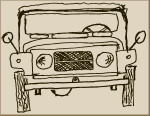
I took my Nissan Patrol G60, 1975. It was pretty much original with only 58,000kms on the clock when I left.
The OLDRD25 was a 3,000kms (1850 miles) trip plus in my case an 800kms trip to the start and a 1,200kms trip return, bringing my trip to an all-round trip of 5,000kms (3,000 miles).
All up the trip was 13 days plus in my case 2 days to get there and 4 days to get home. Making the best part of 3 weeks. I camped but others had caravans, trailer campers or used accommodation in the towns we visited.
The original trip was to head to Cameron Corner, Birdsville the down into South Australia to Maree and the Strzelecki Track. However, rains in Queensland the month or so before caused wide spread flooding down the Darling River and our trip was revised from Birdsville we went south east into Queensland and finished a Quilpie.
For more information look at https://www.olrhd.com.au
Just a note on the flooding. Rains come to Queensland and fill the river systems that flow south-west to South Australia. The river system overflows onto flat country for miles and miles. As the water comes down the river system a varying speed of 30-60 kilometres per day the water spreads out across the country flooding small rural towns and farms/stations. Flood depth varies but often 3-7metres. The length of the Darling is about 1450kms and that then flows into the Murry River system.
The areas we visited were recently flooded. Where usually you see a desert like landscape we had green paddocks.
You need a 4WD for the roads we travelled. In reality you need a vehicle that can handle very rough roads, corrugations, pot holes and cattle grids. All these are hard on the tyres, in particular, as well as on the suspension. You could be going along at reasonable speed (80kph) then hit a rut/pot hole/grid that shook the living daylights out of the tyres and suspension.
Road surfaces varied from sealed highways, a single sealed road, graded dirt roads to very rough ungraded roads.
Road trains were something to watch out for and you needed to move well off the road if one was approaching, apart from lack of room you got showered is dust and rocks. The road trains consist of a prime mover plus up to 3 trailers with a total length of up to 53metres (175ft).
Road Train pic courtesy of the internet.
As mentioned, towns were small. Population ranged from 10-700 persons. We went in Winter when the temperatures are moderate 10-25c. However, in Summer temperatures are very hot 40c with no rain.
Farms/stations are large. In the late 1800s a station named Dunlop was 1 million acres. And the owner had 3 other 1 million acre stations. Today I suspect the stations are smaller. In talking to one farmer who told us he recently did some dingo proof fencing. How long? 148kms (100 miles). How much? $980,000 ($USD 650,000). It a very tough environment to survive.
On our drive from Packsaddle Roadhouse to Cameron Corner – a 300km drive in the desert/arid lands with nothing much in between, we can across a Coffee Caravan on a clay pan open for coffee. We all stopped for coffee. A couple of enterprising locals decided there was a reasonable business with all the 4WD adventurers heading to Cameron Corner to make it worth while. Amazing.
We did a little actual 4WDing (low) on sand dunes of the Simpson Desert which was just out of Birdsville. We did about 40 dunes to the flooded Eyre Creek (which was impassable). This was the only time I went into 4WD. Just a fun day.
My G60 went well for the first 10 days, then I started to get a mis-fire. I managed to limp into camp that day. When I opened the bonnet to investigate the keen Land Rover guys all rushed over to help. We (really they) checked and replaced all the normal ignition thing. The points were ‘closed’ and replacing those did make a difference. However, it was still occasionally misfiring on cylinder 3. Next day I put it back the way it was, with the exception of leaving the points. Still on occasional mis-fire. I decided to keep on going and headed off on the next leg of the trip – a 300kms leg. At high speed – 80-90kms per hour there was only an occasional misfire but during the day it got more often. I decided I would call roadside assist when we reached that night’s town.
I arrived in Quilpie, population 700, and made a call for assistance. An hour later roadside assistance arrived. The guy said “I have one of these G60s, if it was a Land Rover I wouldn’t have come”. He looked around and decided the points were faulty. He said he would go to his G60 and get that set. We met him at his workshop and he started installing the points when he noticed the distributor centre shaft was ‘wobblily’. So off he went to retrieve the distributor from his G60. Once fitted my G60 purred.
The G60 used for parts. It was previously a bull catcher.
Just a bit of a story of the G60 at Quilpie. The roadside assist guy inherited the G60 from the former owner, so it just sat in his yard for the last 10 years. The former owner apparently hooked up a car trailer to the G60 then another car trailer to the first and used to go to Birdsville and bring back 2 cars. That is totally illegal in Australia now, and may have been back then.
The trip was now at an end and we headed home. After day one I adjusted the points. Again they had closed – no real explanation for that. I covered the remaining 900kms home without any problems.
I travelled 5,438 kms (2,380 miles) used 1,180 Litres of fuel (300 gallons)
 . I averages 22L/100kms which was high – I put it down to a faulty distributor and timing may be out a little.
Overall, a great adventure and I look forward to the next trip in a couple of years time. I will be taking a G60.