
1967 Family Patrol Project
-

- You know you own a Patrol when…

- Posts: 489
- Joined: Wed Dec 12, 2012 8:29 pm
- Location: Pasco, Washington
- Has thanked: 529 times
- Been thanked: 301 times
- Contact:
Re: 1967 Family Patrol Project
Isn't there an oil relief spring and ball assembly in the oil filter assembly that could be lifting prior to pushing oil up that far? Anyone have anything on this? Oh and btw, that was meanr to be Galaxy Quest above........
Jeff
50Car
50Car
-
- Patrol Fanatic!

- Posts: 3000
- Joined: Sat Feb 23, 2013 11:28 am
- Location: Lutherville, MD
- Location: Lutherville, MD
- Has thanked: 6010 times
- Been thanked: 1600 times
Re: 1967 Family Patrol Project
The spring and valve assembly in the oil filter only work when there's restriction of flow through the filter. So if that relief is open you still get full pressure in the system. When it actuates the oil bypasses the filter.
Had to look a lot into this when I did the filter conversion.
Had to look a lot into this when I did the filter conversion.
Owner of the same Patrol since 1967
-

- I love driving my Patrol!

- Posts: 1203
- Joined: Fri May 10, 2013 5:35 pm
- Location: Winslow
- Has thanked: 652 times
- Been thanked: 632 times
- Contact:
Re: 1967 Family Patrol Project
These are positive displacement pumps. There should be a pressure relief. Usually these are found in the pump itself. Im not sure where it is on the Patrol pump. 
-
- Patrol Fanatic!
- Posts: 3000
- Joined: Sat Feb 23, 2013 11:28 am
- Location: Lutherville, MD
- Location: Lutherville, MD
- Has thanked: 6010 times
- Been thanked: 1600 times
Re: 1967 Family Patrol Project
The pressure relief valve is integrated in the oil pump body. The old Engine Service Manual even states the procedure for calibrating it based on the length of the spring, on page 60.2869ral wrote:These are positive displacement pumps. There should be a pressure relief. Usually these are found in the pump itself. Im not sure where it is on the Patrol pump.
These are the oil pressure as per the manual:
Running: 3.5 – 4.0 kg/cm2 (50 - 57 psi)
Idling: 0.5 kg/cm2 (7 psi)
The oil filter relief is in the base of the oil filter.
Owner of the same Patrol since 1967
-
- I love driving my Patrol!
- Posts: 1203
- Joined: Fri May 10, 2013 5:35 pm
- Location: Winslow
- Has thanked: 652 times
- Been thanked: 632 times
- Contact:
Re: 1967 Family Patrol Project
Here is a pic of the pressure relief valve. John, im not sure what RPMs your drill is turning. I have a RIGID 1/2 8amp drill, im not sure what RPMs it turning either, but im pulling 45psi at the main oil rail. Maybe you do have a pressure relief issue?
You do not have the required permissions to view the files attached to this post.
-

- Administrator

- Posts: 1225
- Joined: Sun Jul 28, 2013 12:45 am
- Location: Roseville, California
- Has thanked: 646 times
- Been thanked: 1149 times
- Contact:
Re: 1967 Family Patrol Project
Morning update -- I was sure that our second rebuild still has the head off (remember that the valve keeper was pirated from that engine to complete the head during the old-fuel incident) so I drove out to sunny Fair Oaks to do a little poking around. So here we go...
Let's work our way through the system starting at the main oil galley and follow the oil to the top. Behind each galley plug, there is a cross drilled hole that feeds a main bearing. As you can see, behind the plug is a hole... This hole heads to the rear main and cam bearings.

Next, look at the rear cam bearing. The centered hole (front to back on the engine, right side of the picture) lines up with the passage toward the main bearing, connecting with the main oil galley. The second hole, located closer to the front of the engine on the bearing, connects directly to the passage to the top of the block.

By directly to the top of the block, I mean DIRECTLY -- We pointed a light down the oil passage from the top and voila! See the light? That's our flashlight shining down the passage and through the cam bearing.
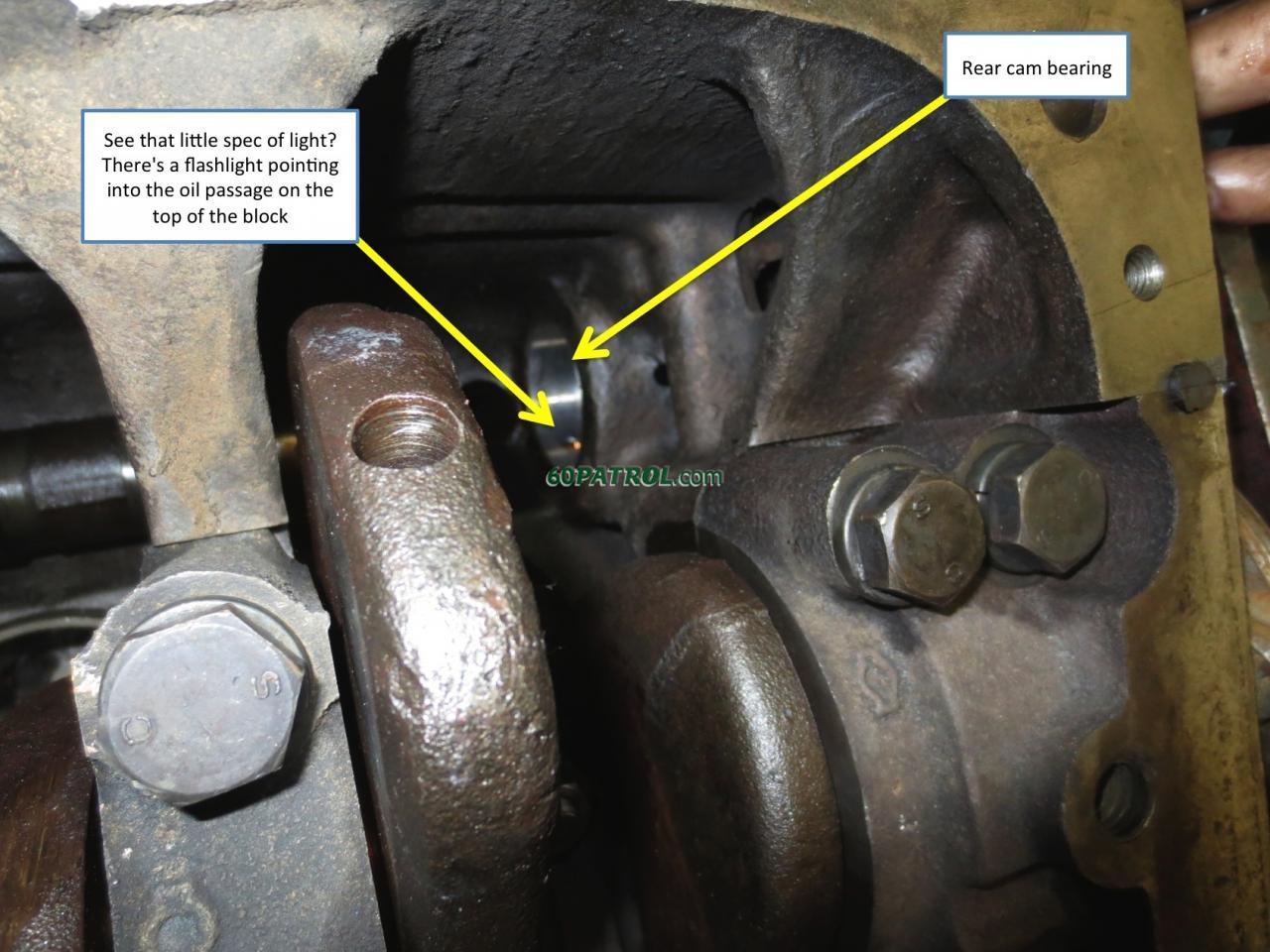
The cam has a groove that wraps the entire journal that lines up with the centered hole in the bearing heading toward the main bearing and oil galley. The bearing hole heading up lines up with the outer end of that little divot. There are actually two divots, 180-degrees apart, that pass oil across from the groove to the head-ward bound oil passage. So, twice per cam revolution, a tiny spurt of oil is pushed upward toward the head. Doesn't seem like a lot, but that's all it gets! This also explains why pressure from above doesn't make it through -- You'd need to have the cam aligned perfectly within two or three degrees to make the connection.

So then, what does this mean for the engine here at home?
I think that there are only a few things that could be causing this...
I'm left with a few choices... all of them stink. I could pull the engine, take it down to the machine shop and see what's what -- That involves pulling the transmission... and I don't want to mess with that! Or, I could pull the pan, water pump and timing cover and then slide the cam out a bit and see what the bearing looks like and how the holes line up... Of course, if the bearing is wrong, I get to pull the engine anyway. If it's correct, then I have no idea
Maybe I'll just roll this beast out into the back yard and bid on the BAT auction Patrol. Kidding -- I wish!
What a fabulous puzzle...
John
Let's work our way through the system starting at the main oil galley and follow the oil to the top. Behind each galley plug, there is a cross drilled hole that feeds a main bearing. As you can see, behind the plug is a hole... This hole heads to the rear main and cam bearings.
Next, look at the rear cam bearing. The centered hole (front to back on the engine, right side of the picture) lines up with the passage toward the main bearing, connecting with the main oil galley. The second hole, located closer to the front of the engine on the bearing, connects directly to the passage to the top of the block.
By directly to the top of the block, I mean DIRECTLY -- We pointed a light down the oil passage from the top and voila! See the light? That's our flashlight shining down the passage and through the cam bearing.
The cam has a groove that wraps the entire journal that lines up with the centered hole in the bearing heading toward the main bearing and oil galley. The bearing hole heading up lines up with the outer end of that little divot. There are actually two divots, 180-degrees apart, that pass oil across from the groove to the head-ward bound oil passage. So, twice per cam revolution, a tiny spurt of oil is pushed upward toward the head. Doesn't seem like a lot, but that's all it gets! This also explains why pressure from above doesn't make it through -- You'd need to have the cam aligned perfectly within two or three degrees to make the connection.
So then, what does this mean for the engine here at home?
I think that there are only a few things that could be causing this...
- 1 - There is some gunk stuck in the passage that's blocking the oil. Honestly, I don't think this is the case, as I've soaked it in carb cleaner and acetone in hopes to dislodge any goo. But, before I give up, I am going to try blasting air down the oil passage, rotating the engine 1-degree, blasting air, rotating 1-degree, repeat, repeat, repeat, repeat, repeat, repeat, repeat...
- 2 - The thrust bearing on the cam could be worn which would allow the cam to sit further back which may screw up the alignment of the holes -- Based on some older, post rebuild, pictures, I can see that the cam gear does not sit flush with the crank gear. The crank gear sits about 1/8" further out than the cam gear -- Can anyone verify how these gears sit?
- 3 - The cam bearing is slightly out of rotational position or pushed in slightly too far or too short so the oil holes do not line up
I'm left with a few choices... all of them stink. I could pull the engine, take it down to the machine shop and see what's what -- That involves pulling the transmission... and I don't want to mess with that! Or, I could pull the pan, water pump and timing cover and then slide the cam out a bit and see what the bearing looks like and how the holes line up... Of course, if the bearing is wrong, I get to pull the engine anyway. If it's correct, then I have no idea
Maybe I'll just roll this beast out into the back yard and bid on the BAT auction Patrol.
Kidding -- I wish!What a fabulous puzzle...
John
-

- Administrator
- Posts: 2460
- Joined: Wed Jul 03, 2013 11:49 pm
- Location: Arizona
- Location: Arizona
- Has thanked: 800 times
- Been thanked: 1269 times
- Contact:
Re: 1967 Family Patrol Project
Keep the faith, my brotha... You'll get it.
now if that were my engine, I would pull the camshaft, just to make sure that:
1) That rear journal (and bearing) are still good, and
2) to PROVE one way or the other that the galley going up to the head is either clogged, or clear, and
3) To test the premise that perhaps the little divot is not lining up with the vertical galley.
now if that were my engine, I would pull the camshaft, just to make sure that:
1) That rear journal (and bearing) are still good, and
2) to PROVE one way or the other that the galley going up to the head is either clogged, or clear, and
3) To test the premise that perhaps the little divot is not lining up with the vertical galley.
L-R:
White 65 Hardtop L60-3-00617 (undergoing restoration)
Red 65 hardtop 4L60-002565 (scrapped for parts)
66 Hardtop "El-Bondo Patrol", L60-00511 (Restored, then sold June2020)
Blue 67 Hardtop (sold March1997)
Green 62 Softtop L60-2-00504 (undergoing restoration)
-
- Patrol Fanatic!
- Posts: 3000
- Joined: Sat Feb 23, 2013 11:28 am
- Location: Lutherville, MD
- Location: Lutherville, MD
- Has thanked: 6010 times
- Been thanked: 1600 times
Re: 1967 Family Patrol Project
John, thanks for sharing these amazing pictures and analysis of the oil problem.  We all are learning, and something that many times is taken for granted - a correct install of the cam bearings - in fact needs to be carefully examined.
Look at the bright side: out of your problems, frustrations, and patience put to an extreme test, everyone of us is benefiting and learning. You have us glued to the screen waiting the new development. I'm confident that you will solve this. Wait, you are very close to finding the culprit.
I totally agree with Robert and his observations.

We all are learning, and something that many times is taken for granted - a correct install of the cam bearings - in fact needs to be carefully examined.Look at the bright side: out of your problems, frustrations, and patience put to an extreme test, everyone of us is benefiting and learning. You have us glued to the screen waiting the new development. I'm confident that you will solve this. Wait, you are very close to finding the culprit.
I totally agree with Robert and his observations.
I don't think it will be toasted. Could be. What if they installed rotated (on a vertical) 180°. The whole pointing down will still be aligned and most certain, the mechanic was looking at this one when installing. But the hole pointing up will be at a different position and the oil passage blocked. I'll bet that something like this is happening.faux40 wrote: [*]3 - The cam bearing is slightly out of rotational position or pushed in slightly too far or too short so the oil holes do not line up [/list]
I suspect that it's #3, but #2 is an option. At least with number two, there's a good chance that the cam journal is fine. With number 3, that final journal is likely toast by now.
John
Owner of the same Patrol since 1967
-
- Administrator
- Posts: 1225
- Joined: Sun Jul 28, 2013 12:45 am
- Location: Roseville, California
- Has thanked: 646 times
- Been thanked: 1149 times
- Contact:
Re: 1967 Family Patrol Project
The more I think about all this, the more I'm convinced that the culprit is the rear cam bearing. Perhaps it's rotated on the vertical axis as Esteban suggested. At least, I would have expected to see tiny pulses on the pressure gauge when I was cranking the engine and achieving 25psi oil pressure while pushing 100+ psi of air down the passage.
- Can the rear cam bearing be extracted and replaced with the engine installed?
- Assuming it's not toast, can a cam bearing be pulled and reinserted safely? Or will a replacement bearing be required either way... with the only real question being "standard" or "undersized"?
If my suspicions are correct, unless the bearing can be swapped in place, the engine has to come out anyway and it will be much easier to disassemble on the floor than in the truck.
Still mulling over our options... Including having an engine pull party this weekend and an engine install party next weekend!
John
Robert, my questions are:moore_rb wrote:Keep the faith, my brotha... You'll get it.
now if that were my engine, I would pull the camshaft, just to make sure that:
1) That rear journal (and bearing) are still good, and
2) to PROVE one way or the other that the galley going up to the head is either clogged, or clear, and
3) To test the premise that perhaps the little divot is not lining up with the vertical galley.
- Can the rear cam bearing be extracted and replaced with the engine installed?
- Assuming it's not toast, can a cam bearing be pulled and reinserted safely? Or will a replacement bearing be required either way... with the only real question being "standard" or "undersized"?
If my suspicions are correct, unless the bearing can be swapped in place, the engine has to come out anyway and it will be much easier to disassemble on the floor than in the truck.
Still mulling over our options... Including having an engine pull party this weekend and an engine install party next weekend!
John
-
- Patrol Fanatic!
- Posts: 3000
- Joined: Sat Feb 23, 2013 11:28 am
- Location: Lutherville, MD
- Location: Lutherville, MD
- Has thanked: 6010 times
- Been thanked: 1600 times
Re: 1967 Family Patrol Project
Robert is probably sleeping while I write this:faux40 wrote: Robert, my questions are:
- Can the rear cam bearing be extracted and replaced with the engine installed?
- Assuming it's not toast, can a cam bearing be pulled and reinserted safely? Or will a replacement bearing be required either way... with the only real question being "standard" or "undersized"?
If my suspicions are correct, unless the bearing can be swapped in place, the engine has to come out anyway and it will be much easier to disassemble on the floor than in the truck.
Still mulling over our options... Including having an engine pull party this weekend and an engine install party next weekend!
John
To change the rear cam bearing, you need to take a plug in the back of the block. For that, the bellhousing and flywheel need to come out. And of course the transmission. Installing the camshaft bearing requires some special tools in order to avoid damaging the bearing. This step will either need to be done at the shop or borrow their tools. I have never done it, since it was always a machine shop item.
The other possibility that I see, if in fact the bearing was installed rotated in its vertical axis, is to drill a new hole in the bearing from above
 , if the oil passage to the upper part is a straight shot. Or borrow from your dentist an angled drill and make the hole from the inside of the bearing and going up now that you know the exact location of that hole (sounds like a Wile E. Coyote and Acme industries idea but doable) Crucial will be controlling all the debris from the drilling in any case.
You will need to take the camshaft out or at least slide it forward a good bit.
- drain oil
- remove oil pan
- remove lifters
- remove radiator
- remove water pump
- raise front of engine to allow pulley to come out
- remove crankshaft pulley
- remove timing cover
- slide camshaft out
EDIT:
The amount of work is substantial in any case. If by dropping the oil pan, somehow you could check if oil is getting to the rear camshaft without any further dismantling and it's indeed getting oil, I would then go with the idea of the bypass
Owner of the same Patrol since 1967