
John, your some of your drawings make a lot of sense and help understand some issues, but others are incorrect, specially the ones dealing with pressure inside the system.
The following is taken from an article "Basic Hydraulic Theory":
http://www.crossmfg.com/technical/basic ... lic-theory
The basis for all hydraulic systems is expressed by Pascal's law which states
that the pressure exerted anywhere upon an enclosed liquid is transmitted undiminished,
in all directions, to the interior of the container.
With the above, the pressure of 100 psi at the Master Cylinder is also 100 psi at each slave cylinder.
The second misconception is regarding the "second master cylinder". What you have in your diagram are 2 independent pumps that doesn't happen in a car. Actually is one pump with two pistons inside, interdependent on each other. The pressure applied at the first piston moves the second one.
Here are some good and simple diagrams: "How Master Cylinders and Combination Valves Work"
http://auto.howstuffworks.com/auto-part ... brake1.htm
http://www.onallcylinders.com/2012/07/1 ... akes-work/
If you change a 1-inch bore single circuit master cylinder to a 1-inch double circuit one, the same pedal effort will take place, and pedal travel should be the same as well.
Converting to dual reservoir brake master cylinder
-
- Patrol Fanatic!

- Posts: 3007
- Joined: Sat Feb 23, 2013 11:28 am
- Location: Lutherville, MD
- Location: Lutherville, MD
- Has thanked: 6023 times
- Been thanked: 1605 times
-

- Administrator

- Posts: 1225
- Joined: Sun Jul 28, 2013 12:45 am
- Location: Roseville, California
- Has thanked: 646 times
- Been thanked: 1149 times
- Contact:
Re: Converting to dual reservoir brake master cylinder
Thanks Esteban -- I see where I went wrong on my explanation. Now I'm compulsively required to fix it... professor Esteban  showed me the light! It was the word "interdependent" that did the trick. That "floating" master cylinder is cool! I hadn't thought of that!
I'll post fixes soon... However, right now I heading out to pick up my lovely wife and kids from summer camp! Yay! It's even more exciting than usual this year. A friend is flying me from Auburn to Chester, where Emily has left the car, so I'll only have to drive about a half hour instead of the usual three (to get there... we still need to drive home. It's been way too long since I've been up in a small plane. I'm looking forward to it.
John
showed me the light! It was the word "interdependent" that did the trick. That "floating" master cylinder is cool! I hadn't thought of that!I'll post fixes soon... However, right now I heading out to pick up my lovely wife and kids from summer camp! Yay! It's even more exciting than usual this year. A friend is flying me from Auburn to Chester, where Emily has left the car, so I'll only have to drive about a half hour instead of the usual three (to get there... we still need to drive home.
It's been way too long since I've been up in a small plane. I'm looking forward to it.John
You do not have the required permissions to view the files attached to this post.
-

- Administrator
- Posts: 7824
- Joined: Thu Oct 04, 2012 10:42 am
- Location: Temecula, CA
- Has thanked: 7727 times
- Been thanked: 2481 times
- Contact:
Re: Converting to dual reservoir brake master cylinder
What did someone say about feeling like they just walked into the smart kids class?  Yeah, I get it.
That's what we need - more Patrol owner that are engineers.
Yeah, I get it. That's what we need - more Patrol owner that are engineers.
Beyond any hope for intervention

-

- You know you own a Patrol when…

- Posts: 391
- Joined: Wed Oct 03, 2012 2:45 pm
- Location: San Francisco Bay Area
- Location: Martinez California
- Has thanked: 195 times
- Been thanked: 54 times
- Contact:
Re: Converting to dual reservoir brake master cylinder
Yeah cause dummies like me are so interdependent on them! 
-

- Administrator
- Posts: 2460
- Joined: Wed Jul 03, 2013 11:49 pm
- Location: Arizona
- Location: Arizona
- Has thanked: 800 times
- Been thanked: 1269 times
- Contact:
Re: Converting to dual reservoir brake master cylinder
Above, I have summarized Esteban's brilliant post into the 3 summary points that everyone needs to understand if they want to master the master cylinder...Esteban wrote:
1) The basis for all hydraulic systems is expressed by Pascal's law which states
that the pressure exerted anywhere upon an enclosed liquid is transmitted undiminished,
in all directions, to the interior of the container.[/i]
With the above, the pressure of 100 psi at the Master Cylinder is also 100 psi at each slave cylinder.
2) The pressure applied at the first piston in a dual circuit MC moves the second one. pressure is uniform
3) If you change a 1-inch bore single circuit master cylinder to a 1-inch double circuit one, the same pedal effort will take place, and pedal travel should be the same as well.
Here are my own supporting factoids:
1) Pressure generated by the piston within the master cylinder does NOT increase or decrease due to any increase or decrease in the the number of outlets, or reservoirs, Period- The pressure (and pedal feel, effort) are inherently designed into the Master cylinder based on the the rate at which the bleedback valves on the piston allow the fluid pressure to normalize itself within the MC.
2) Pedal travel and feel can be influenced by changing the fluid volume moving through the system , and fluid volume could be impacted by the number/orientation of your MC outlets, or by changing the inside diameter of your brake lines, or by changing the diameter of the bore itself... adding RESERVOIR capacity (or changing the the number of reservoirs) does NOT influence these factors in any way, because the reservoir is not part of the pressurized internal system- it is part of the surrounding atmosphere...
This has been an energetic conversation- I almost feel guilty that I have not ordered a MC yet...

L-R:
White 65 Hardtop L60-3-00617 (undergoing restoration)
Red 65 hardtop 4L60-002565 (scrapped for parts)
66 Hardtop "El-Bondo Patrol", L60-00511 (Restored, then sold June2020)
Blue 67 Hardtop (sold March1997)
Green 62 Softtop L60-2-00504 (undergoing restoration)
-
- Administrator
- Posts: 2460
- Joined: Wed Jul 03, 2013 11:49 pm
- Location: Arizona
- Location: Arizona
- Has thanked: 800 times
- Been thanked: 1269 times
- Contact:
Re: Converting to dual reservoir brake master cylinder
Johnny Roadkill wrote:in my limited experience, pedal feel and travel are hugely dependent on master cylinder bore...
yes, because changing bore diameter changes volume within the system - however, if you doubled the bore, and halved the ratio of the MC, you can be assured that it would feel the same.
the stock patrol has a 1 inch bore and a 1:1 ratio (one inch bore, one inch stroke)
The wilwood MC I linked above has a 1:1.1 ratio (50/50 volume output), so it moves the same cross sectional fluid volume a 10% longer distance - which means it will feel just a TAD softer.
The Corvette MC I linked to above has a 1:1 ratio (also biased 50/50) so it should feel darn near identical to a stock Patrol MC
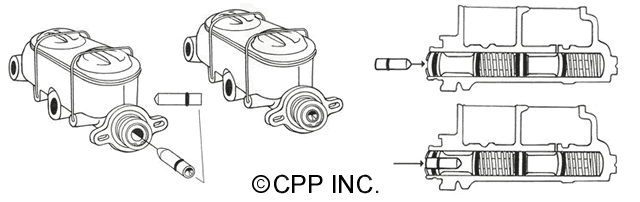
Here is a nice image that shows the interior workings of a 2 reservoir MC- note there are 2 pistons and two return springs , and the pedal activates them BOTH simultaneously:
L-R:
White 65 Hardtop L60-3-00617 (undergoing restoration)
Red 65 hardtop 4L60-002565 (scrapped for parts)
66 Hardtop "El-Bondo Patrol", L60-00511 (Restored, then sold June2020)
Blue 67 Hardtop (sold March1997)
Green 62 Softtop L60-2-00504 (undergoing restoration)
-
- Administrator
- Posts: 2460
- Joined: Wed Jul 03, 2013 11:49 pm
- Location: Arizona
- Location: Arizona
- Has thanked: 800 times
- Been thanked: 1269 times
- Contact:
Re: Converting to dual reservoir brake master cylinder
Just a quick update on this topic- I decided which Master Cylinder I am going to use on my green Patrol:
This is a dual reservoir, dual circuit, one inch bore MC originally for a 1967 Chevrolet C10 pickup 4x2, with 4 wheel drums and built in 50/50 bias - $26 at the neighborhood O'Reiley Auto Parts Store:

Based on my research, this one should offer nearly identical braking power and pedal feel to the stock Patrol MC, but with the benefit of isolated front/rear circuits...
Nothing left to do but fab up an adaptor for the bolt pattern, hook it up, and see if I'm right...
This is a dual reservoir, dual circuit, one inch bore MC originally for a 1967 Chevrolet C10 pickup 4x2, with 4 wheel drums and built in 50/50 bias - $26 at the neighborhood O'Reiley Auto Parts Store:
Based on my research, this one should offer nearly identical braking power and pedal feel to the stock Patrol MC, but with the benefit of isolated front/rear circuits...
Nothing left to do but fab up an adaptor for the bolt pattern, hook it up, and see if I'm right...
L-R:
White 65 Hardtop L60-3-00617 (undergoing restoration)
Red 65 hardtop 4L60-002565 (scrapped for parts)
66 Hardtop "El-Bondo Patrol", L60-00511 (Restored, then sold June2020)
Blue 67 Hardtop (sold March1997)
Green 62 Softtop L60-2-00504 (undergoing restoration)
-
- Administrator
- Posts: 1225
- Joined: Sun Jul 28, 2013 12:45 am
- Location: Roseville, California
- Has thanked: 646 times
- Been thanked: 1149 times
- Contact:
Re: Converting to dual reservoir brake master cylinder
Howdy All,
After my post earlier in this thread where I made some big mistakes, I wanted to figure out and understand the whole brake thing myself. In order to do this, I chose to write a paper on brakes. It turned out a bit on the long side (which fits with the honor of "most longwinded" that moore_rb has bestowed on me! ), but with any luck, it works its way through some basic hydraulic calculations and how they work in context of brakes. Anyway, you can download the pdf here (http://balestrini.net/images/patrol_bra ... alysis.pdf) if you want to read it in long form. And, just to be convenient, here it is in images.
I hope you like it (and maybe it's useful!)
John

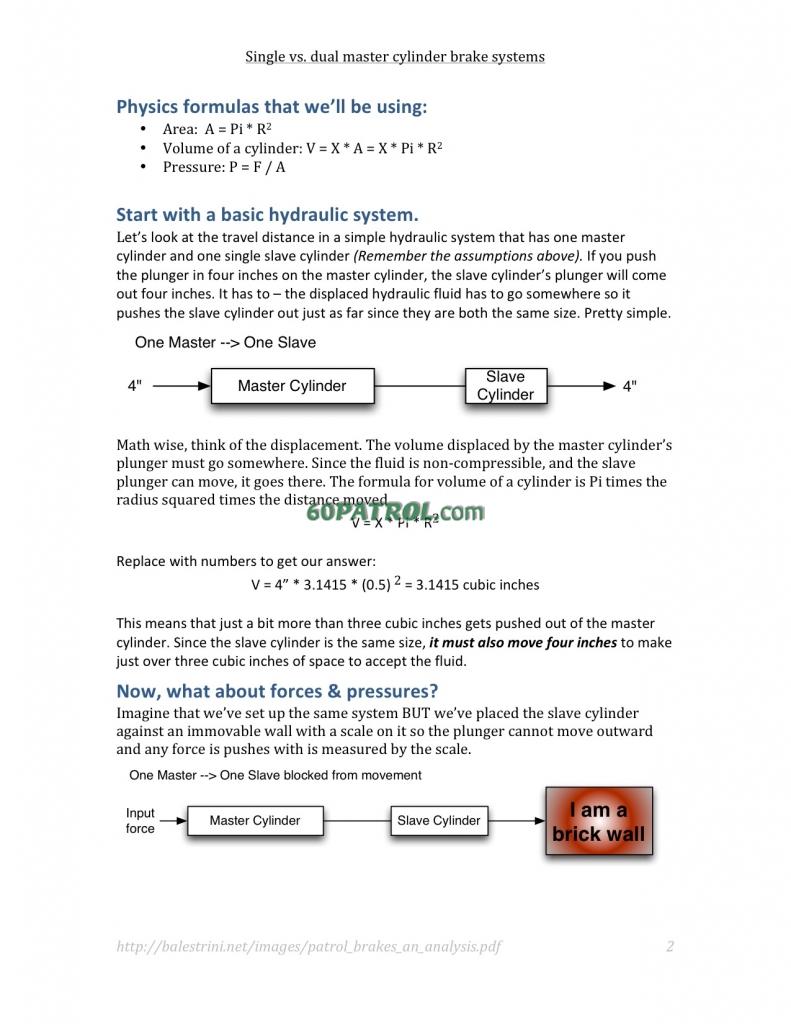
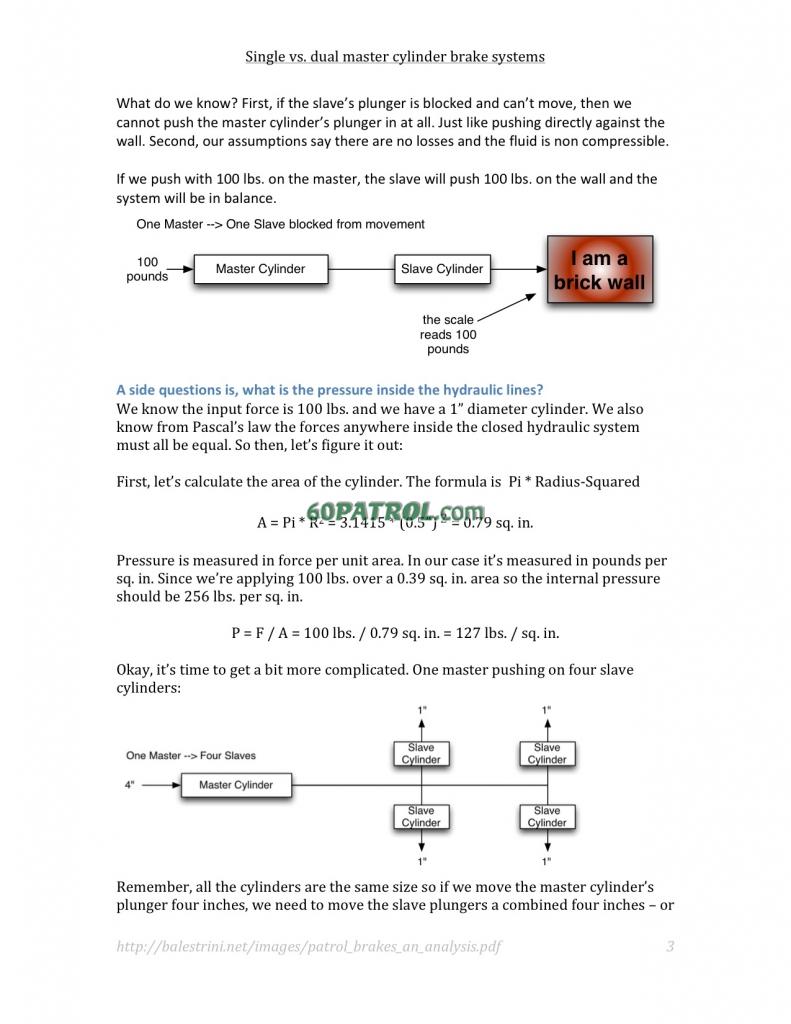

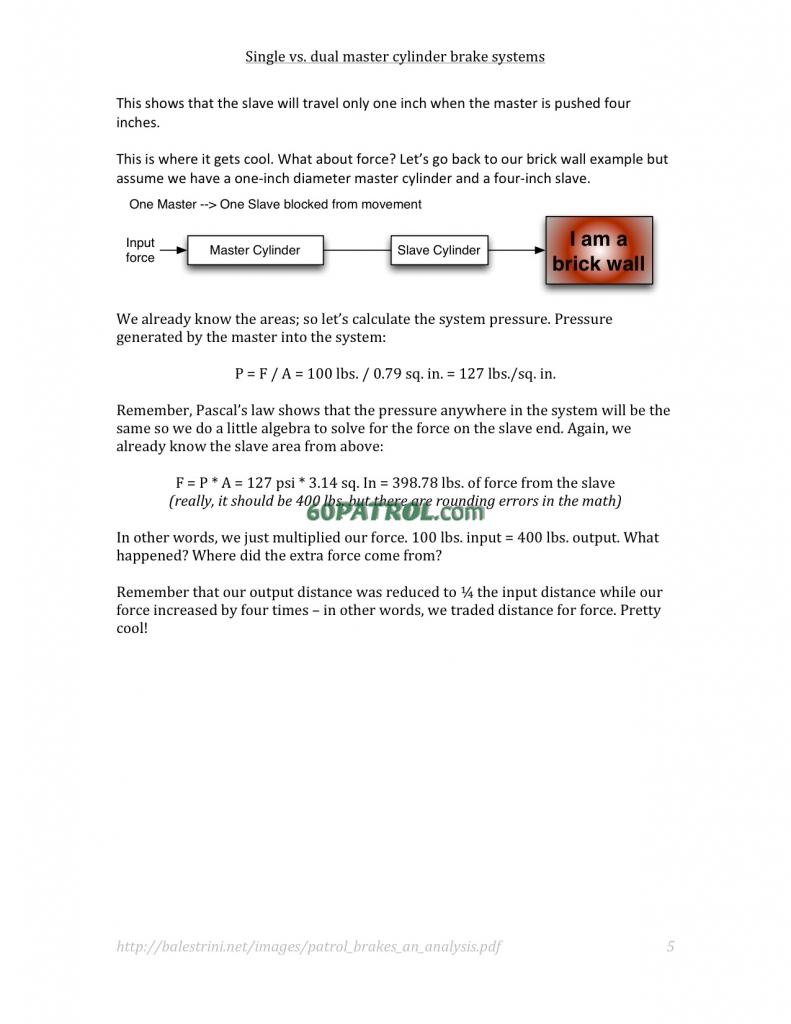
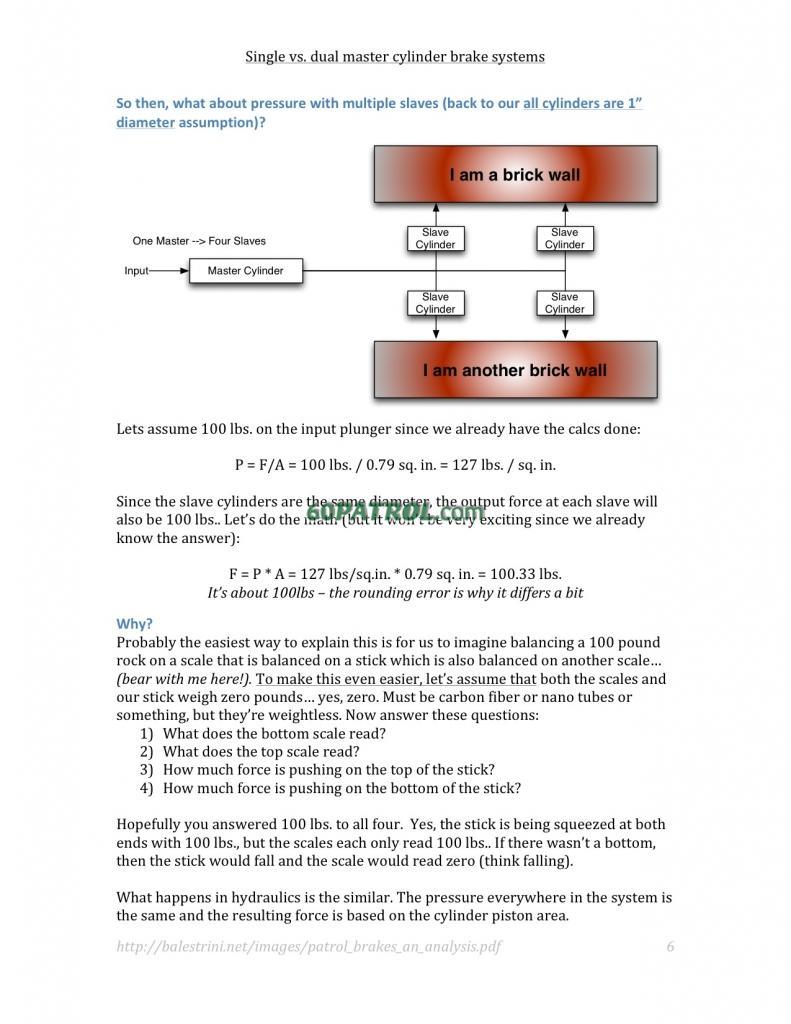
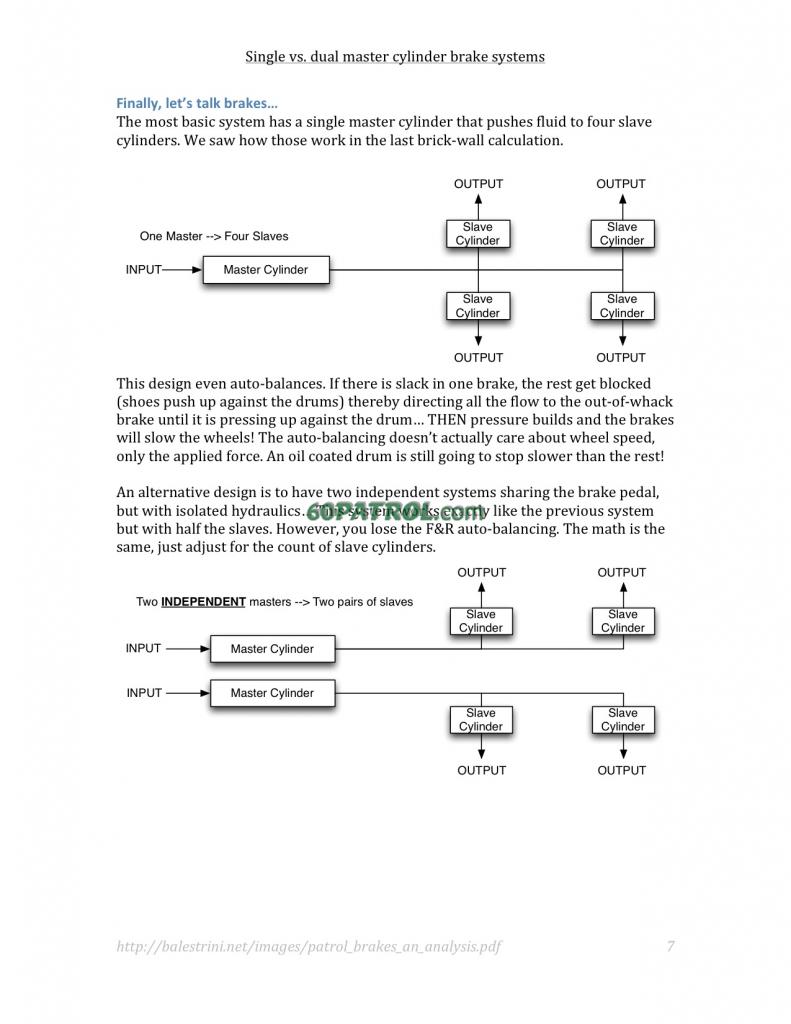

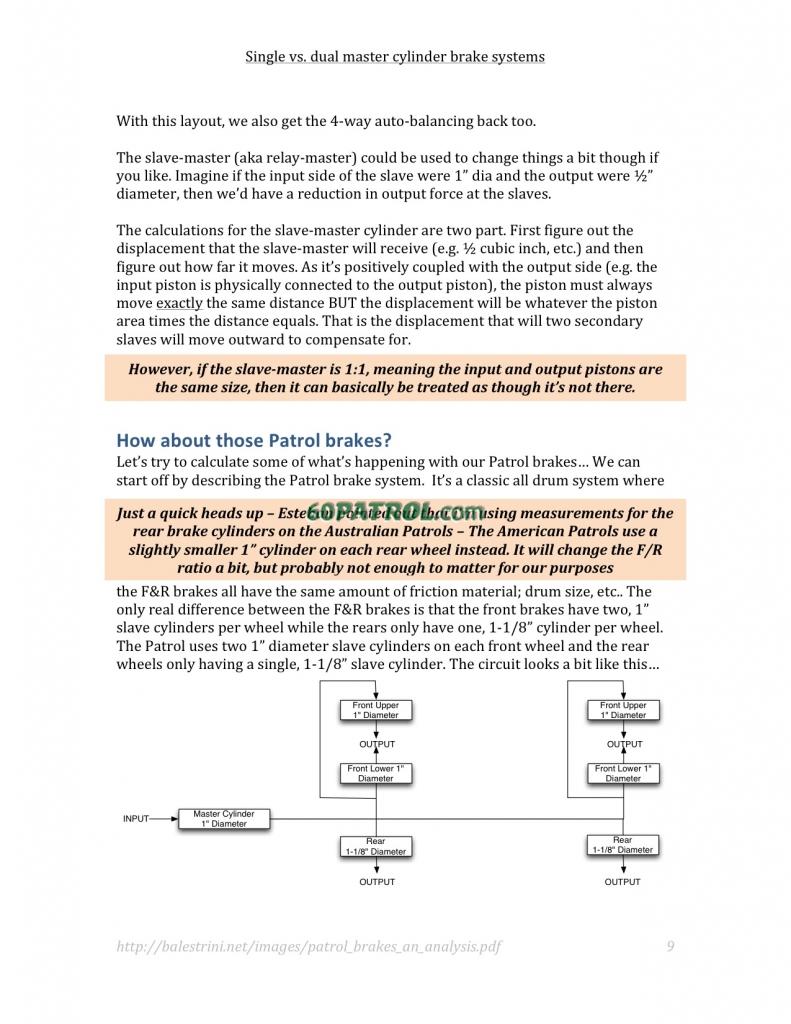
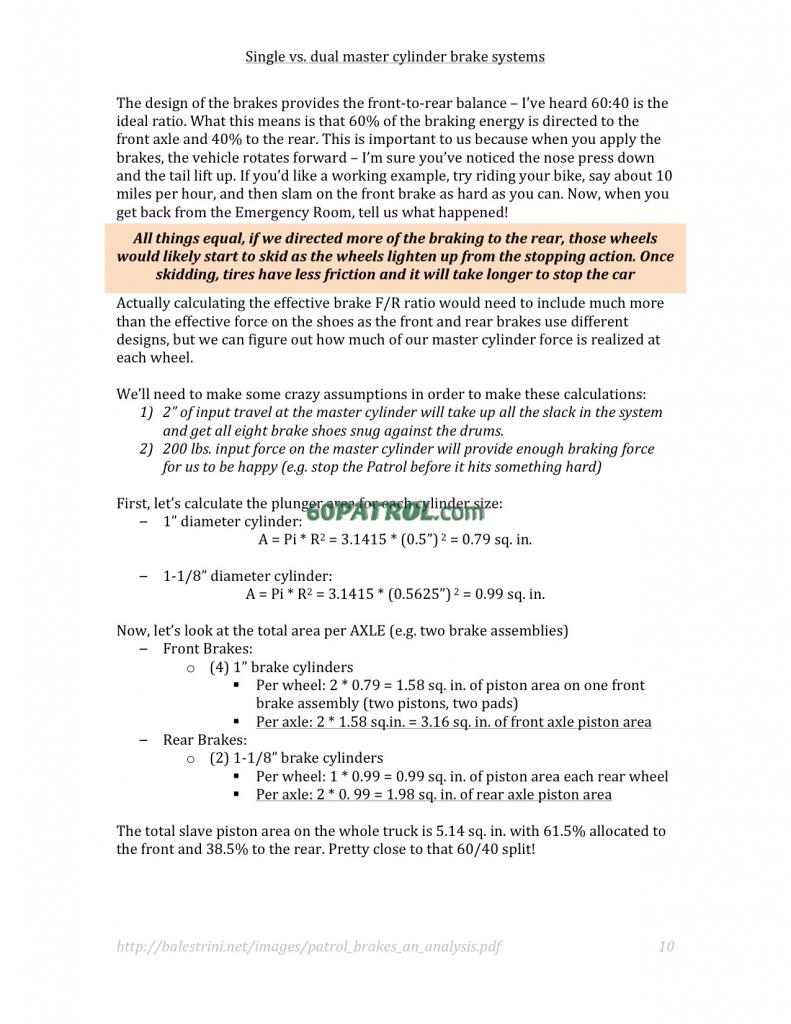

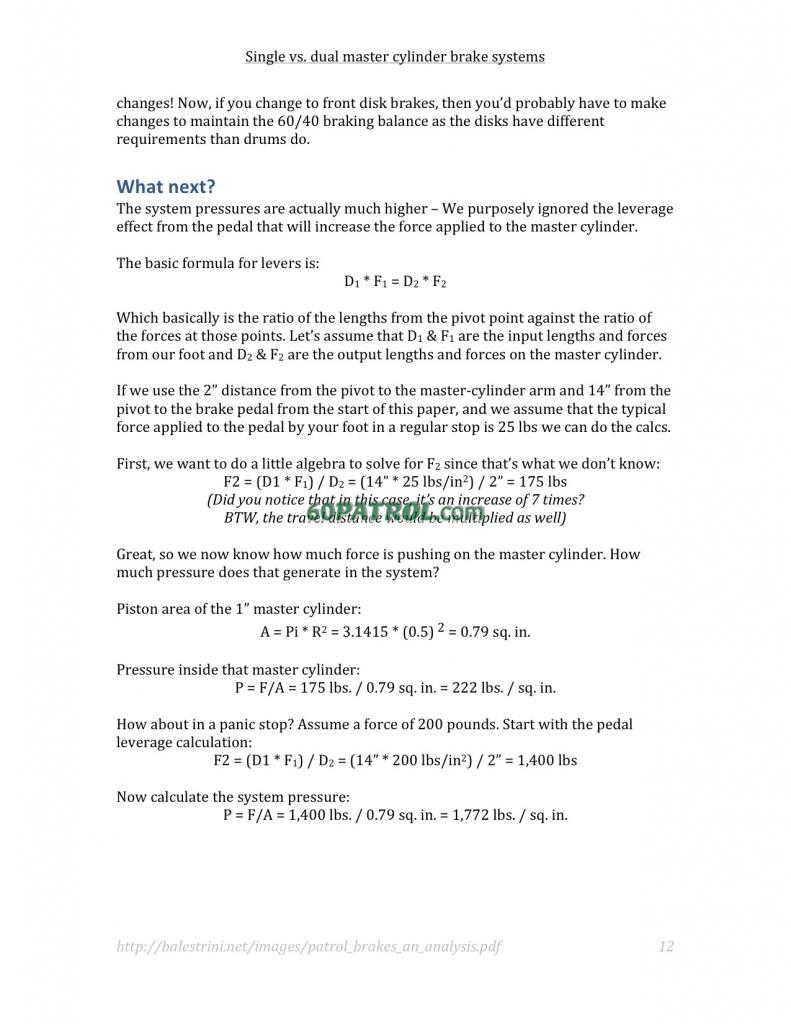

After my post earlier in this thread where I made some big mistakes, I wanted to figure out and understand the whole brake thing myself. In order to do this, I chose to write a paper on brakes. It turned out a bit on the long side (which fits with the honor of "most longwinded" that moore_rb has bestowed on me!
), but with any luck, it works its way through some basic hydraulic calculations and how they work in context of brakes. Anyway, you can download the pdf here (http://balestrini.net/images/patrol_bra ... alysis.pdf) if you want to read it in long form. And, just to be convenient, here it is in images.I hope you like it (and maybe it's useful!)
John
-
- Administrator
- Posts: 7824
- Joined: Thu Oct 04, 2012 10:42 am
- Location: Temecula, CA
- Has thanked: 7727 times
- Been thanked: 2481 times
- Contact:
Re: Converting to dual reservoir brake master cylinder
Outstanding! Thank all of you - John, Esteban and Chris for all of the research and effort that went into this. I'll admit I only skimmed it for now, but I have yet to see anything this comprehensive regarding the Patrol braking system. 
Beyond any hope for intervention
-
- Administrator
- Posts: 2460
- Joined: Wed Jul 03, 2013 11:49 pm
- Location: Arizona
- Location: Arizona
- Has thanked: 800 times
- Been thanked: 1269 times
- Contact:
Re: Converting to dual reservoir brake master cylinder
Very awesome writeup...!
And, I can say that I learned something - I was ready to jump on the fact that US Patrols have 1 inch rear wheel cylinders, and that the entire system is "square" ; but then I saw that the 1-1/8 rear cylinders are for MWB Patrols - interesting little factoid.
The dual reservoir cylinder in my post above is perfect for anyone who wants to convert their Patrol to a dual reservoir, but wants to maintain non-power brakes. I'll be adding my "How to" steps to this thread as soon as I make the conversion on my Patrol (it will probably be a couple more weeks)
I also just noticed I did not post the part number- it is a Cardone BHH 10-1329...
And, I can say that I learned something - I was ready to jump on the fact that US Patrols have 1 inch rear wheel cylinders, and that the entire system is "square" ; but then I saw that the 1-1/8 rear cylinders are for MWB Patrols - interesting little factoid.
The dual reservoir cylinder in my post above is perfect for anyone who wants to convert their Patrol to a dual reservoir, but wants to maintain non-power brakes. I'll be adding my "How to" steps to this thread as soon as I make the conversion on my Patrol (it will probably be a couple more weeks)
I also just noticed I did not post the part number- it is a Cardone BHH 10-1329...
L-R:
White 65 Hardtop L60-3-00617 (undergoing restoration)
Red 65 hardtop 4L60-002565 (scrapped for parts)
66 Hardtop "El-Bondo Patrol", L60-00511 (Restored, then sold June2020)
Blue 67 Hardtop (sold March1997)
Green 62 Softtop L60-2-00504 (undergoing restoration)